
Maritime Risk Bootcamp
Our Maritime Risk Bootcamp Rotational offers students hands-on experience through real-world projects. Collaborating with experts from the Department of Homeland Security Center of Excellence, students tackle important national defense and security topics. The Bootcamp adapts to the ever-changing professional landscape, ensuring that each rotation provides a unique experience, with new challenges and opportunities every semester.
Industry Experts as Advisors
Projects span 10-15 weeks a semester
Enrolling students every semester
8-10 hour weekly time commitment from students
3-6 person student teams per project
Meet the Experts Who’ll Guide Your Journey
Learn from industry professionals who bring real-world experience and personalized mentorship to every step of your path.

Karen Bemis
PHD
Advisor, Maritime Risk Bootcamp
Senior Advisor, Scientist and Research Faculty Member with over 30 years of experience in marine science and data visualization. Since joining the Rutgers Professional Science Master’s (PSM) program, Dr. Bemis has been a key member of the leadership team and serves as the Assistant Director of the MBS Externship Exchange, where she empowers students to develop the skills and competencies necessary for success in their future careers.

Brian Petrus
PHD
Advisor, Maritime Risk Bootcamp
Senior Advisor with extensive experience in the education sector, specializing in Human Resources and Project Management. Brian has supported the MBS Externship Exchange Program since 2020, empowering students to cultivate the knowledge, skills, abilities, and other competencies essential for their future career trajectories. He currently serves as an Associate Professor of Business Administration at Westminster College in New Wilmington, PA.
Past Areas of Exploration
Our students have gained invaluable experience by tackling real-world maritime challenges, such as autonomous systems, the evolving landscape of cybercrime, and the complexities of maritime security and enforcement.
Projects from Recent Bootcamps
Evaluating Cybersecurity & Infrastructure Risks
Summer 2024
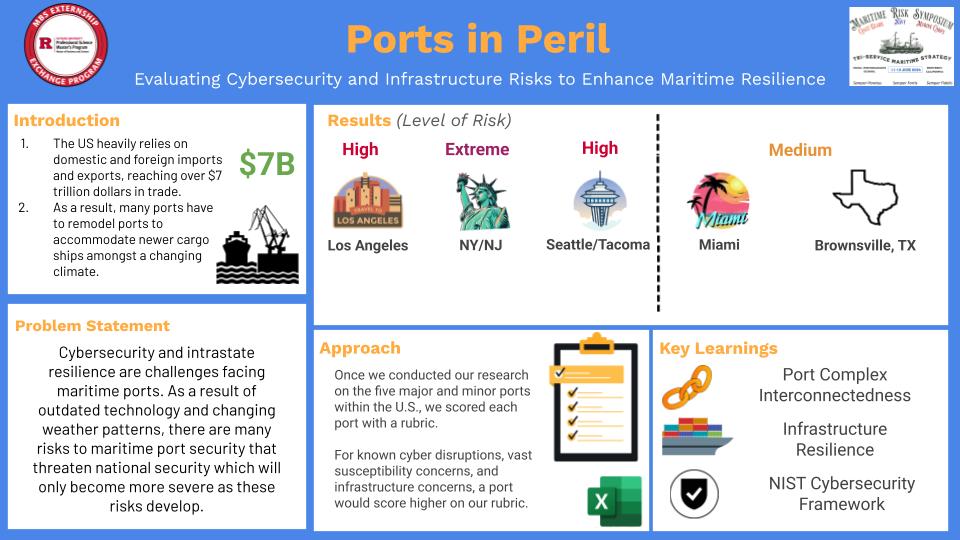
Team
Christopher Di Paolo, Ulari Maduekwe, Derya Kirca, Giovanna Lorenzetti, Sneha Shinde
Abstract
This project focused on evaluating cybersecurity and infrastructure risks to enhance maritime resilience. A comprehensive risk assessment rubric was developed for five major and minor ports in the United States, and specific risks were categorized to effectively identify vulnerabilities. By systematically researching and quantifying these risks, the team aimed to improve the overall security and resilience of maritime operations.
Mitigating Cyber Threats to the Maritime Industry
Summer 2023
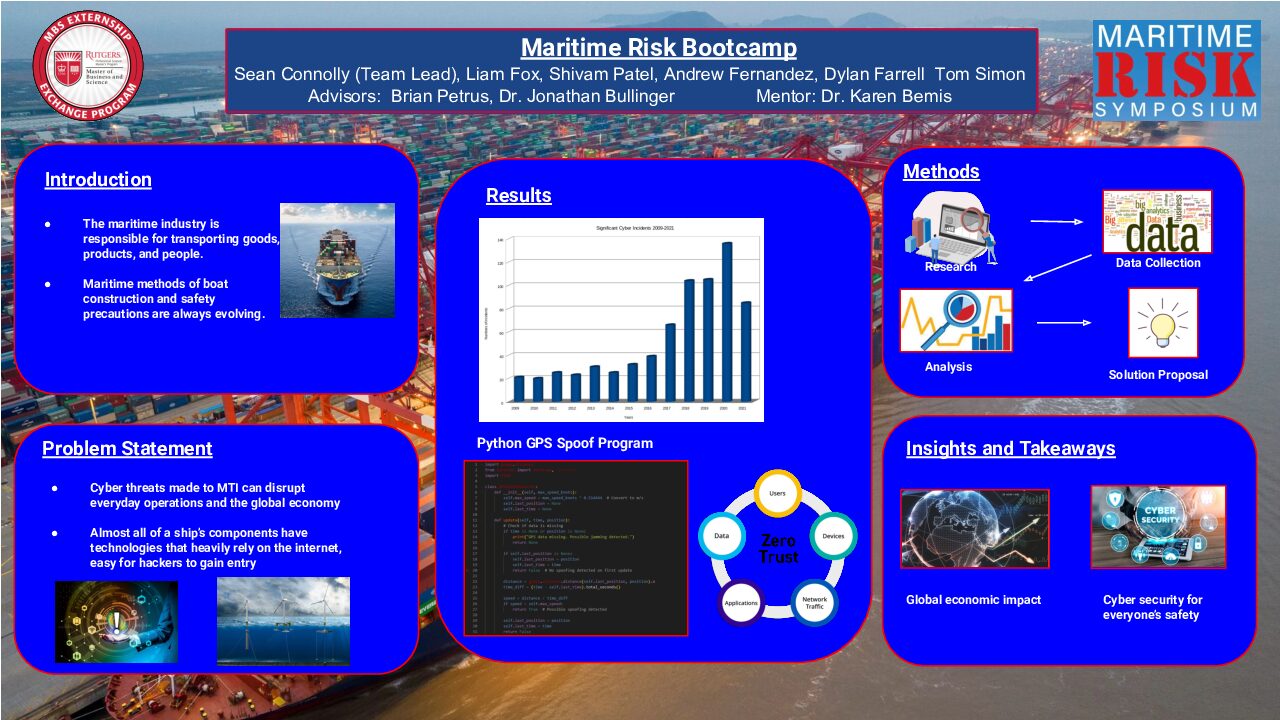
Team
Shivam Patel, Andrew Fernandez, Sean Connolly, Tom Simon, Dylan Farrell, Liam Fox
Abstract
This project examined the Maritime Industries’ offshore energy infrastructure and its associated cybersecurity vulnerabilities. By assessing the environmental and technological risks of offshore energy port infrastructure, the Maritime Risk Bootcamp team evaluated and provided recommendations for addressing cyber threats with a high likelihood of severely impacting maritime operations. The project also outlined potential consequences for companies if these concerns were not addressed in a systematic manner.
Risk Assessment of the Maritime Transportation Industry
Summer 2022

Team
Amritpal Singh, Farid Mamoor, Hasan Bhuiyan, Tawhid Ahmad
Abstract
This bootcamp focused on maritime risk where students looked into areas of interest around the maritime industry and potential areas of risk to supply chains. These areas of risk included inland waterways and infrastructure, climate change impediments, and training the next generation of maritime cybersecurity workers. The team presented a poster at the Fall 2022 Maritime Risk Symposium.